
Rhinoplasty Recovery Timeline: Week 1 to One Year
A broad rhinoplasty recovery timeline covering splints, early return, swelling and the long refinement period.
Explore this procedure in 3D
Turn the face, compare before treatment and move through the illustrative recovery stages for the selected region.
Compare recovery stages
Drag sideways to rotate · Pinch or scroll to zoom
Comparison, camera & procedure details
Two stages shown at the same angle and scale.
Shown before day 7 in this example. Removal timing varies; follow your surgical team’s instructions. Turn off to inspect the skin.
What changes in this example · 365 days after
Early days are spaced out so you can follow the visible changes.
- Narrower nose with more projection
This one-year picture is an authored comparison, not an individual recovery deadline.
Technique, the amount of structural change and individual tissue response affect timing. Morning swelling can fluctuate; recovery is not always a smooth decline.
Example contour
This example starts with a lower bridge and a wider, less projecting tip, then illustrates increased projection and narrowing. Early swelling broadens the nose; bruising is shown around the eyes. Residual tip swelling fades on a separate, longer clock.
Treatment date · Elapsed time
365 days after treatmentIllustrated range: 0–365 days
Customize display faceFemale · European / North American · Skin tone 4
Appearance settings only. Every face follows the same example recovery course.
Recovery at a glance
Rhinoplasty
Watch early nasal fullness and under-eye bruising give way to slower contour refinement.
A general recovery example based on public medical guidance. Timing and visible changes vary from person to person.
Refinement can continue for a year. A one-month appearance is not the final result.
Cartilage grafts: septum, ear and rib
Nasal reshaping may use cartilage from the septum inside the nose, or from the ear or rib. These are different donor sites for structural support; the visible contour alone does not identify which was used.
This example shows an external contour and recovery stages. It does not compare graft materials, implant types, donor-site healing or graft survival. The contour control is not a graft-size selector.
Silicone implants are manufactured material, while cartilage grafts use tissue. Either may be used to add nasal structure; the visible contour does not identify the material.
ASPS · RhinoplastySources & how this preview works
Public medical guidance informs the stage descriptions. The 3D swelling, color and contour changes are drawn examples, not patient measurements or a prediction of your result.
- ASPS · Rhinoplasty recovery
Early swelling, splints and longer-term refinement.
- ASPS · What to expect during rhinoplasty recovery
External dressings commonly worn for the first week, under-eye bruising and later gradual change.
- Cleveland Clinic · Bruise color changes
Explains complexion-dependent bruise colors and possible lighter brown, green or yellow as they fade. Color alone does not determine the recovery day.
Sources checked .
Read the complete recovery guideRhinoplasty Recovery Timeline
Initial rhinoplasty recovery takes weeks, but the nasal contour can continue refining for up to a year or longer. A splint or packing may be used early, swelling can fluctuate, and the surgeon’s individual restrictions take priority over any general timeline.
Timeline at a glance
Returning to work and seeing the final contour are not the same milestone. The visible result continues changing long after the earliest recovery phase.
Protected early healing
Splints, packing or external dressings may support the nose during the initial phase.
Early return varies
Bruising and prominent swelling may be improving, but activity restrictions remain individualized.
Still refining
A substantial amount of swelling may have improved while the tip and deeper tissues continue settling.
Long refinement
The final nasal contour can take a year or longer to refine, and swelling may fluctuate during that time.
The bars show relative visibility within this guide only. They are not percentages, clinical measurements or personal forecasts.
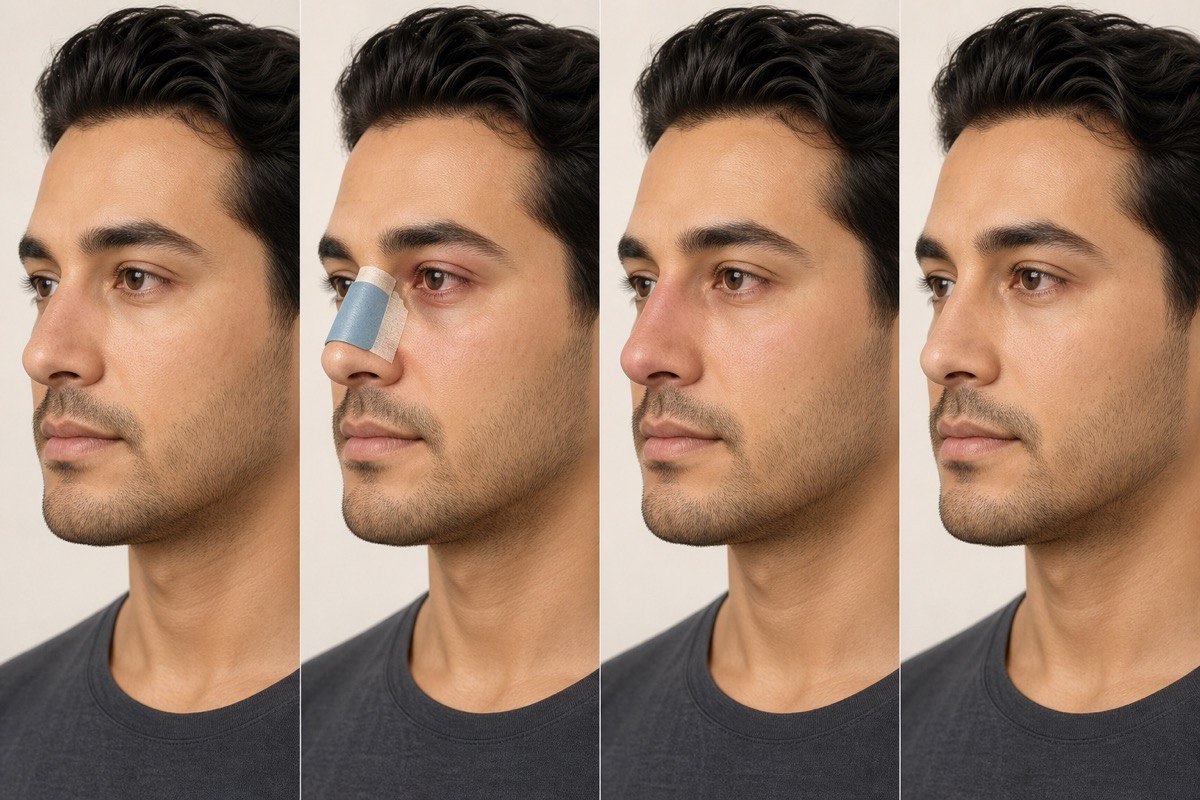
Why the nose can keep changing for a year
Rhinoplasty can alter bone, cartilage and the soft-tissue envelope that covers them. Early bruising may resolve relatively quickly, while deeper swelling—especially around the nasal tip—can take much longer to refine.
An open or closed approach, grafting, skin thickness and whether breathing structures were treated all change the recovery pattern. Return to work is therefore not evidence that the final contour has arrived.
Deeper visual interpretation
Rhinoplasty has at least three clocks: the splint-and-bruising clock, the social-visibility clock and the slower structural-settling clock. Mixing them is why a person can look ready for work while the nose is still far from its later contour.
| Clock | What it tracks | Why it matters |
|---|---|---|
| Early care | Splint, drainage, bruising, congestion and activity restrictions | This period is driven by the surgeon’s exact technique and instructions |
| Social visibility | How noticeable bruising and swelling are to other people | Lighting, skin tone, makeup rules and the type of event change what ‘ready’ means |
| Structural settling | Tip definition, residual swelling and scar-tissue remodeling | This can continue for many months after normal daily activities resume |
How to interpret the stages
A recovery timeline combines broad observations from published patient guidance. It cannot know the exact product or device, treatment depth, technique, medical history, skin characteristics or aftercare plan involved in one person’s case.
Use the stages to understand the order in which changes may happen and to prepare questions for a qualified professional. Do not use a general internet timeline to override instructions from the clinician who assessed and treated you.
Aftercare principles
- Follow the surgeon’s instructions for dressings, incision care and medication.
- Protect the nose from pressure, impact and unapproved activity.
- Ask the surgeon when exercise, glasses and contact sports can resume.
- Attend scheduled follow-up appointments even when the outside looks improved.
Contact the surgical team for worsening pain, heavy bleeding, breathing concerns, fever, signs of infection or any symptom identified in the discharge plan.
Why your timeline may differ
Questions to ask before treatment
- What structures and functional issues will the operation address?
- How long must splints, taping or activity restrictions continue?
- Who should be contacted after hours for bleeding or breathing concerns?
Specialist titles and board-certification systems are not equivalent across countries. Confirm the surgeon’s local registration, hospital privileges, anesthesia setting and follow-up plan rather than relying on an overseas title alone.
Find official checks for 12 marketsHow this guide was made
2 named sources support the main claims. Each link explains how it was used, with public agencies, professional bodies or primary research preferred.
AI may assist with research organization, drafting and translation, but it is not treated as a source or credential. Read the editorial standards.
Stage bars organize a relative sequence. Original editorial illustrations are conceptual and are not clinical measurements, outcome percentages or personal forecasts.
This version has editorial evidence review, not medical review attributed to a named clinician. It does not replace an individual assessment. Editorial accountability.
Sources
- American Society of Plastic Surgeons: Rhinoplasty Recovery
Early support, swelling and the long contour-refinement period.
- ASPS: What to Expect From Rhinoplasty Recovery
General return-to-activity and long-term swelling context.
Frequently asked questions
What should I know about Rhinoplasty Recovery Timeline?
Initial rhinoplasty recovery takes weeks, but the nasal contour can continue refining for up to a year or longer. A splint or packing may be used early, swelling can fluctuate, and the surgeon’s individual restrictions take priority over any general timeline.
Why can the timeline differ from person to person?
Treatment type, depth, technique, anatomy, skin and tissue response, health history, medication, aftercare and complications can all change timing. The treating professional’s instructions take priority over a general guide.
When should I contact a professional?
Contact the surgical team for worsening pain, heavy bleeding, breathing concerns, fever, signs of infection or any symptom identified in the discharge plan.
Open the complete rhinoplasty guide
Connect recovery, activity-specific aftercare, septoplasty differences, risks and international follow-up without confusing return to routine with the final result.
Explore the rhinoplasty topic hubCompare this recovery time
See this treatment beside 10 other skincare, injectable, surgical, body and hair timelines without treating the ranges as personal clearance dates.
Open the 11-treatment comparisonRelated beauty guides
View Plastic SurgeryRhinoplasty Aftercare: Sleeping, Glasses, Exercise and Nose Blowing
Rhinoplasty aftercare for sleep position, glasses, nose blowing, work and exercise—with source differences and surgeon-specific limits.
Read next PLASTIC SURGERYRhinoplasty vs Septoplasty: Appearance, Breathing, Recovery and Risks
Compare rhinoplasty and septoplasty by treatment goal, anatomy, breathing, recovery, risks and when both may be combined.
Read next PLASTIC SURGERYBreast Augmentation Recovery Timeline: First Week to Week 6
A general guide to soreness, swelling, support garments, activity limits and early implant settling after breast augmentation.
Read nextThis guide is for general education only. It is not medical advice, diagnosis, a treatment recommendation or a prediction of individual results. BeautiNext is not a clinic. Seek care from an appropriately qualified professional.