
Rhinoplasty vs Septoplasty: Appearance, Breathing, Recovery and Risks
Compare rhinoplasty and septoplasty by treatment goal, anatomy, breathing, recovery, risks and when both may be combined.
Rhinoplasty vs Septoplasty
Rhinoplasty changes the external appearance and/or structural form of the nose. Septoplasty straightens or repairs the internal nasal septum to improve airflow when a deviated septum contributes to obstruction. They are not interchangeable, but they can be performed together when both form and function need treatment.
Timeline at a glance
The useful comparison starts with the problem being treated. A profile concern, a blocked airway and a combined structural problem require different examinations, records and outcome measures.
Appearance, airflow or both
Describe what you see and what you feel without choosing an operation first. Persistent obstruction may need nasal examination rather than a cosmetic photograph alone.
Map external and internal structures
The clinician may assess skin, bone, cartilage, septum, nasal valves, prior trauma or surgery and other causes of breathing difficulty before naming a plan.
One procedure or a combined plan
Rhinoplasty, septoplasty or septorhinoplasty can overlap, but the intended changes, anesthesia, surgeon, facility and follow-up must be stated clearly.
Measure the correct outcome
External swelling and internal airflow do not stabilize on the same clock. Review appearance, breathing and complications as separate outcomes.
The bars show relative visibility within this guide only. They are not percentages, clinical measurements or personal forecasts.
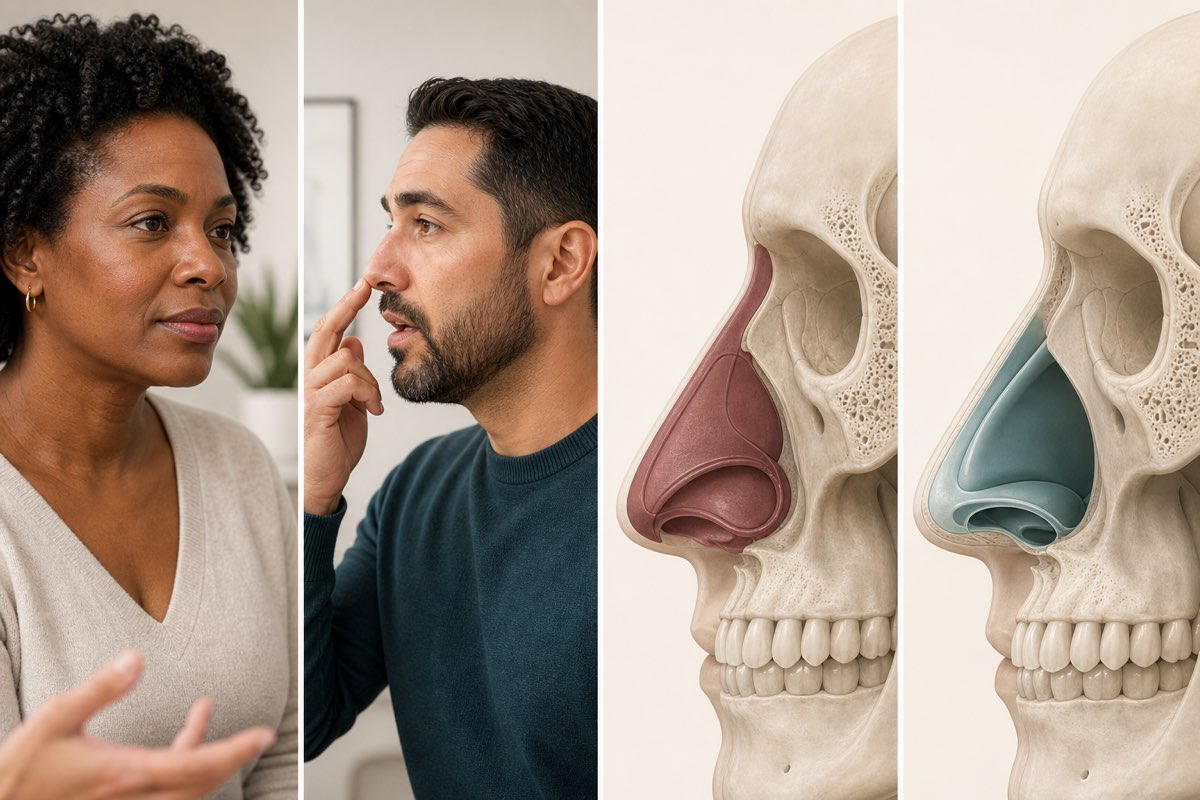
Changing the contour and opening the airway are different goals
Rhinoplasty can change bone, cartilage and the external soft-tissue envelope to address appearance, structure or both. Septoplasty primarily treats a deviated internal septum to improve the passage of air.
A visible deviation does not by itself identify the cause of obstruction. The septum, nasal valves, turbinates, inflammation, allergies and previous surgery can all contribute; examination determines whether a combined plan is appropriate.
Deeper visual interpretation
The words sound similar because both operations involve the nose, but the decision is not cosmetic versus medical by name alone. The surgeon must state which external and internal structures are changing and what outcome each step is meant to improve.
| Question | Rhinoplasty may address | Septoplasty may address |
|---|---|---|
| Primary target | External shape and structural form | Internal nasal septum |
| Common outcome measure | Proportion, contour and structural support | Airflow symptoms and internal examination |
| Can they overlap? | Yes, when external and functional changes are planned | Yes, as part of a combined septorhinoplasty |
| What not to assume | That every rhinoplasty is purely cosmetic | That septoplasty changes the visible nose shape by itself |
Prepare a useful consultation record
- Describe the symptom
Record obstruction by side, timing, sleep, exercise, allergies, trauma and prior treatment separately from appearance goals.
- Name each planned structure
Ask which bone, cartilage, septum, valve or other tissue is involved and how that finding was established.
- Keep two outcome measures
Plan how external contour and breathing will each be assessed rather than treating one photograph as proof of both.
- Map follow-up
Identify who manages bleeding, infection, obstruction, dissatisfaction or revision—especially after international travel.
How to interpret the stages
A recovery timeline combines broad observations from published patient guidance. It cannot know the exact product or device, treatment depth, technique, medical history, skin characteristics or aftercare plan involved in one person’s case.
Use the stages to understand the order in which changes may happen and to prepare questions for a qualified professional. Do not use a general internet timeline to override instructions from the clinician who assessed and treated you.
Aftercare principles
- Write down whether each proposed step addresses external form, internal airflow or both.
- Ask what examination supports a deviated-septum or nasal-valve diagnosis and whether allergies or other conditions also affect breathing.
- Confirm which specialist will perform each part, where anesthesia occurs and who manages complications or later obstruction.
- Discuss insurance or public-system coverage using functional documentation rather than assuming all combined surgery is cosmetic or covered.
- If traveling internationally, arrange local examination and records transfer before booking a combined operation.
New severe breathing difficulty, heavy bleeding, fever, escalating pain, visual symptoms, clear watery drainage after trauma or rapidly worsening swelling needs urgent assessment. Persistent obstruction cannot be diagnosed from an online profile image.
Why your timeline may differ
Questions to ask before treatment
- Which symptom or finding does each planned step address?
- How will breathing be documented before and after surgery?
- Is the proposed operation rhinoplasty, septoplasty or septorhinoplasty, and why?
- Which risks relate to external shape and which to the septum or airway?
- Who follows both function and appearance if I travel for surgery?
Terminology, coverage, qualified specialties and functional documentation differ by health system. Verify the professional, facility, anesthesia setting and local follow-up for every component of the plan.
Find official checks for 12 marketsHow this guide was made
4 named sources support the main claims. Each link explains how it was used, with public agencies, professional bodies or primary research preferred.
AI may assist with research organization, drafting and translation, but it is not treated as a source or credential. Read the editorial standards.
Stage bars organize a relative sequence. Original editorial illustrations are conceptual and are not clinical measurements, outcome percentages or personal forecasts.
This version has editorial evidence review, not medical review attributed to a named clinician. It does not replace an individual assessment. Editorial accountability.
Sources
- Cleveland Clinic: Rhinoplasty
Rhinoplasty types, form-and-function goals, comparison with septoplasty, recovery and risks.
- Cleveland Clinic: Septoplasty
Internal septum purpose, airflow, initial recovery, risks and combination with rhinoplasty.
- Mayo Clinic: Rhinoplasty
Planning, anatomy, breathing indications, septal correction, risks and individualized operation design.
- American Society of Plastic Surgeons: Rhinoplasty Safety
Rhinoplasty risk categories, breathing changes, septal perforation, revision and consent questions.
Frequently asked questions
What should I know about Rhinoplasty vs Septoplasty?
Rhinoplasty changes the external appearance and/or structural form of the nose. Septoplasty straightens or repairs the internal nasal septum to improve airflow when a deviated septum contributes to obstruction. They are not interchangeable, but they can be performed together when both form and function need treatment.
Why can the timeline differ from person to person?
Treatment type, depth, technique, anatomy, skin and tissue response, health history, medication, aftercare and complications can all change timing. The treating professional’s instructions take priority over a general guide.
When should I contact a professional?
New severe breathing difficulty, heavy bleeding, fever, escalating pain, visual symptoms, clear watery drainage after trauma or rapidly worsening swelling needs urgent assessment. Persistent obstruction cannot be diagnosed from an online profile image.
Open the complete rhinoplasty guide
Connect recovery, activity-specific aftercare, septoplasty differences, risks and international follow-up without confusing return to routine with the final result.
Explore the rhinoplasty topic hubRelated beauty guides
View Plastic SurgeryRhinoplasty Aftercare: Sleeping, Glasses, Exercise and Nose Blowing
Rhinoplasty aftercare for sleep position, glasses, nose blowing, work and exercise—with source differences and surgeon-specific limits.
Read next PLASTIC SURGERYRhinoplasty Recovery Timeline: Week 1 to One Year
A broad rhinoplasty recovery timeline covering splints, early return, swelling and the long refinement period.
Read next PLASTIC SURGERYBreast Augmentation Recovery Timeline: First Week to Week 6
A general guide to soreness, swelling, support garments, activity limits and early implant settling after breast augmentation.
Read nextThis guide is for general education only. It is not medical advice, diagnosis, a treatment recommendation or a prediction of individual results. BeautiNext is not a clinic. Seek care from an appropriately qualified professional.