
Breast Augmentation Recovery Timeline: First Week to Week 6
A general guide to soreness, swelling, support garments, activity limits and early implant settling after breast augmentation.
Breast Augmentation Recovery
Acute discomfort often improves during the first one to five days, while soreness and swelling can continue for weeks. The NHS describes return to most normal activities at about six weeks and a more natural look and feel after several months, but implant placement, surgical technique, work demands and the surgeon’s instructions can change that substantially. Breast implants are not lifetime devices, so recovery planning and long-term device follow-up are separate responsibilities.
Timeline at a glance
Feeling ready for desk work, being cleared for exercise and seeing a more settled breast shape are separate milestones.
Monitored early recovery
Dressings and a support bra may be used while soreness, tightness, fatigue and swelling are monitored.
Acute discomfort improves
Pain commonly decreases, but activity remains deliberately limited because early bleeding and swelling are still concerns.
Gradual return
Some people return to non-physical work while soreness, swelling and movement restrictions continue to improve.
Early recovery milestone
Normal activity may resume only when the surgeon clears it. Shape and softness can continue changing beyond this point.
The bars show relative visibility within this guide only. They are not percentages, clinical measurements or personal forecasts.
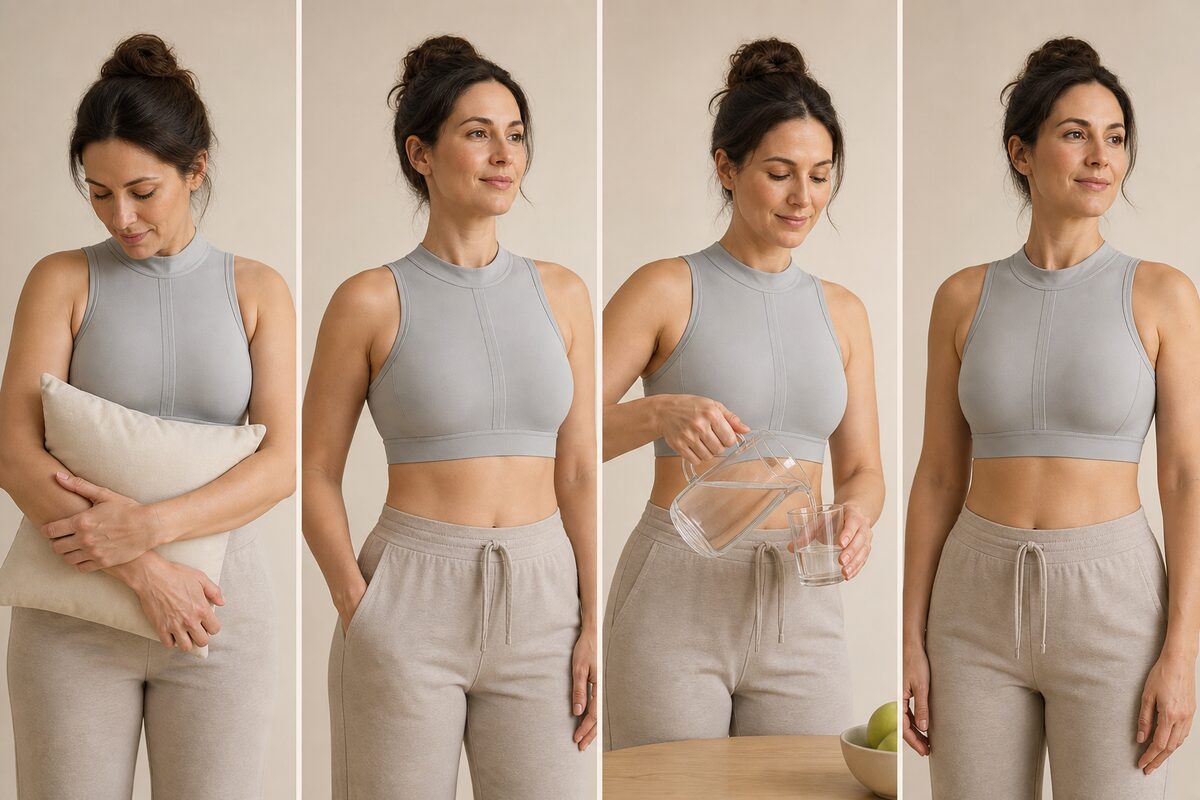
Why placement changes the recovery experience
Breast augmentation creates a surgical pocket for an implant or, in some operations, transfers fat. Tissue stretching, incision healing and the implant’s relationship to the chest muscle all influence tightness, soreness and early position.
Implant shape, surface, size, incision and placement are part of long-term follow-up as well as initial recovery. Feeling better after one week does not remove lifting restrictions or the need to monitor implants over time.
Deeper visual interpretation
Breast augmentation has at least three clocks: surgical recovery, gradual position and softness changes, and lifelong implant surveillance. Reaching a six-week activity milestone does not mean the device no longer needs monitoring.
| Clock | What it tracks | What it does not prove |
|---|---|---|
| Early surgical recovery | Pain, bleeding, wounds, swelling and protected movement | That lifting, driving or physical work is already safe |
| Shape settling | Position, softness, residual swelling and scar change | A guaranteed final size, symmetry or result date |
| Long-term device follow-up | Rupture, capsular contracture, displacement and device-specific surveillance | That an implant is a lifetime device |
Build a record that can travel with you
- Keep the device card
Save manufacturer, model, surface, size, serial or lot details and the date of surgery.
- Preserve the operative summary
Record incision, implant pocket, any combined procedure and the facility and surgeon contacts.
- Separate follow-up dates
Keep wound reviews, activity clearance and later implant surveillance as distinct appointments.
- Tell imaging providers
Inform mammography and other breast-imaging teams that implants are present before the examination.
How to interpret the stages
A recovery timeline combines broad observations from published patient guidance. It cannot know the exact product or device, treatment depth, technique, medical history, skin characteristics or aftercare plan involved in one person’s case.
Use the stages to understand the order in which changes may happen and to prepare questions for a qualified professional. Do not use a general internet timeline to override instructions from the clinician who assessed and treated you.
Aftercare principles
- Wear the support garment exactly as instructed.
- Follow the surgeon’s incision, medication and sleeping-position plan.
- Avoid lifting and strenuous exercise until specifically cleared.
- Keep every scheduled follow-up, even if the outside appearance seems improved.
Contact the surgical team urgently for chest pain, breathing difficulty, heavy bleeding, fever, one-sided rapidly increasing swelling, worsening redness or severe pain.
Why your timeline may differ
Questions to ask before treatment
- What implant and placement are recommended, and why?
- What follow-up imaging or long-term monitoring is expected?
- Which one-sided changes require urgent contact?
Implant approvals, device registries, warranty systems and recommended surveillance vary by country. Ask for the exact device documentation and how follow-up will work if you later live elsewhere.
Find official checks for 12 marketsHow this guide was made
4 named sources support the main claims. Each link explains how it was used, with public agencies, professional bodies or primary research preferred.
AI may assist with research organization, drafting and translation, but it is not treated as a source or credential. Read the editorial standards.
Stage bars organize a relative sequence. Original editorial illustrations are conceptual and are not clinical measurements, outcome percentages or personal forecasts.
This version has editorial evidence review, not medical review attributed to a named clinician. It does not replace an individual assessment. Editorial accountability.
Sources
- American Society of Plastic Surgeons: Breast Augmentation Recovery
Dressings, support garments, early pain, swelling and activity guidance.
- ASPS: How Long Is Breast Augmentation Recovery?
A broad stage-by-stage recovery overview and factors that change timing.
- NHS: Breast Enlargement (Implants)
Work, driving, lifting, six-week activity and later settling context plus implant complications.
- FDA: Things to Consider Before Getting Breast Implants
U.S. device labeling, non-lifetime-device warning, reoperation, monitoring and long-term risk context.
Frequently asked questions
What should I know about Breast Augmentation Recovery?
Acute discomfort often improves during the first one to five days, while soreness and swelling can continue for weeks. The NHS describes return to most normal activities at about six weeks and a more natural look and feel after several months, but implant placement, surgical technique, work demands and the surgeon’s instructions can change that substantially. Breast implants are not lifetime devices, so recovery planning and long-term device follow-up are separate responsibilities.
Why can the timeline differ from person to person?
Treatment type, depth, technique, anatomy, skin and tissue response, health history, medication, aftercare and complications can all change timing. The treating professional’s instructions take priority over a general guide.
When should I contact a professional?
Contact the surgical team urgently for chest pain, breathing difficulty, heavy bleeding, fever, one-sided rapidly increasing swelling, worsening redness or severe pain.
Compare two surgery and implant quotes
Separate the initial procedure, implant device, recovery, travel and documented follow-up amounts without predicting replacement or revision.
Open the breast augmentation cost calculatorCompare this recovery time
See this treatment beside 10 other skincare, injectable, surgical, body and hair timelines without treating the ranges as personal clearance dates.
Open the 11-treatment comparisonRelated beauty guides
View Plastic SurgeryRhinoplasty Aftercare: Sleeping, Glasses, Exercise and Nose Blowing
Rhinoplasty aftercare for sleep position, glasses, nose blowing, work and exercise—with source differences and surgeon-specific limits.
Read next PLASTIC SURGERYRhinoplasty vs Septoplasty: Appearance, Breathing, Recovery and Risks
Compare rhinoplasty and septoplasty by treatment goal, anatomy, breathing, recovery, risks and when both may be combined.
Read next PLASTIC SURGERYRhinoplasty Recovery Timeline: Week 1 to One Year
A broad rhinoplasty recovery timeline covering splints, early return, swelling and the long refinement period.
Read nextThis guide is for general education only. It is not medical advice, diagnosis, a treatment recommendation or a prediction of individual results. BeautiNext is not a clinic. Seek care from an appropriately qualified professional.