
Nonsurgical Body Contouring: Recovery and Results Timeline
Compare fat freezing, heat, ultrasound and magnetic body-contouring timelines, side effects, results and device-specific risks.
Nonsurgical Body Contouring Timeline
Most nonsurgical body-contouring procedures do not require surgical downtime, but they do not share one results timeline. Temporary redness, swelling, bruising or discomfort can occur; the American Academy of Dermatology says device-based fat-removal changes may appear from about three weeks, with fuller effects commonly assessed three to six months after the last treatment. Results can be subtle, temporary or absent, and these procedures do not cause weight loss.
Timeline at a glance
The first question is not simply how long body contouring takes. It is which technology is being used, what tissue it targets and whether the clock describes surface recovery, a series of sessions or later results.
Identify the exact device
Cooling, radiofrequency, light, ultrasound and magnetic-field devices have different intended effects, contraindications and complications. Record the manufacturer, model and treated body site.
Local response may be visible
Depending on the technology, redness, swelling, bruising, tenderness, numbness or muscle soreness can occur. Many people can resume ordinary activity, but device-specific instructions still apply.
Some fat-reduction changes may emerge
AAD says device-based changes can be noticed from about three weeks. FDA notes that fat damaged by cryolipolysis is usually cleared gradually over two to three months.
Assess the planned endpoint
AAD places the fuller effect for many device-based fat-removal treatments between three and six months after the last session. Some technologies produce temporary effects or need multiple sessions and maintenance.
The bars show relative visibility within this guide only. They are not percentages, clinical measurements or personal forecasts.
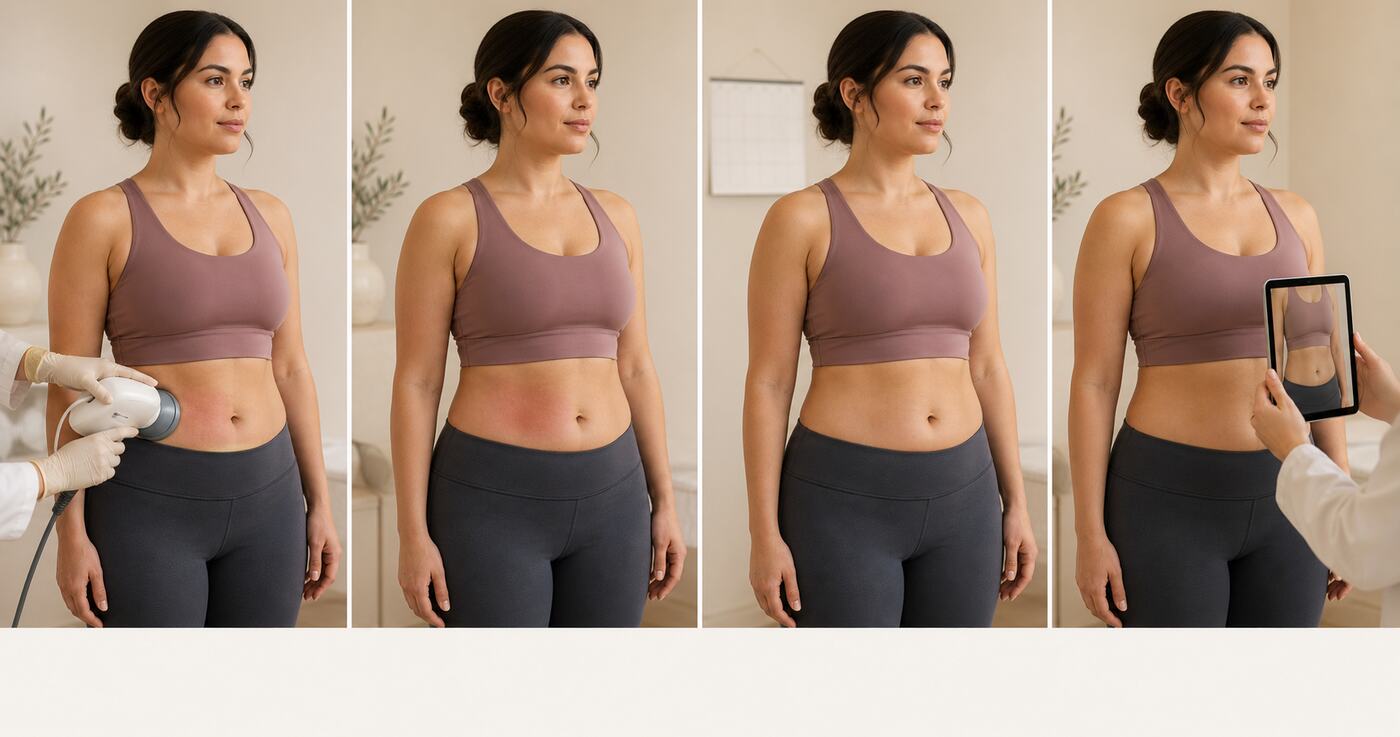
Why there is no single body-sculpting timeline
Cryolipolysis cools a small fat bulge, while radiofrequency, laser or ultrasound devices deliver different forms of energy. Magnetic-field devices primarily trigger muscle contractions, and massage or vibration may temporarily change cellulite appearance. These are not interchangeable treatments even when a clinic calls all of them body sculpting.
Recovery and results also use different clocks. Surface redness or soreness can settle before a gradual contour change is assessable, while a delayed complication can appear after the skin looks normal. The exact authorized body site and intended effect must be checked for the specific device in the country where treatment occurs.
Deeper visual interpretation
Body contouring is a service category, not one mechanism. A credible timeline identifies the exact device and separates the surface-response clock, the result clock and the delayed-complication clock.
| Technology | Primary concept | Do not assume |
|---|---|---|
| Cryolipolysis | Controlled cooling of a small fat bulge | That later enlargement is normal settling; PAH can emerge two to five months later |
| RF, laser or ultrasound | Different energy forms may heat or disrupt selected tissue | That all devices share settings, contraindications or burn risk |
| Magnetic field | Repeated muscle contractions | That muscle-tone claims equal fat removal or permanent change |
| Massage or vibration | Temporary change in fluid or cellulite appearance | That a short-lived circumference change represents fat loss |
Document the device before documenting the result
- Photograph the label
Record the manufacturer and model, not only the clinic's marketing name.
- Name the intended effect
Ask whether the claim concerns localized fat, circumference, cellulite, skin firmness or muscle tone.
- Fix the comparison
Use the same posture, clothing, camera height, distance and time of day for later photographs.
- Keep symptoms off the photo
Write down pain, numbness, firmness and timing because a contour image cannot show them.
How to interpret the stages
A recovery timeline combines broad observations from published patient guidance. It cannot know the exact product or device, treatment depth, technique, medical history, skin characteristics or aftercare plan involved in one person’s case.
Use the stages to understand the order in which changes may happen and to prepare questions for a qualified professional. Do not use a general internet timeline to override instructions from the clinician who assessed and treated you.
Aftercare principles
- Keep the exact device name, treatment area, settings or treatment summary and patient information supplied by the clinic.
- Follow technology-specific advice for skin care, sun exposure, exercise and symptom monitoring rather than a generic body-sculpting checklist.
- Use consistent clothing, posture, lighting, camera distance and measurements when comparing subtle contour changes.
- Do not use home fat-freezing equipment; the FDA says the safety and effectiveness of over-the-counter or home-use fat freezing have not been established.
Contact the treating professional promptly for burns, blisters, severe or increasing pain, persistent numbness, marked color change, weakness or any reaction outside the device-specific plan. After fat freezing, a firm raised bulge that enlarges in the applicator shape two to five months later can be paradoxical adipose hyperplasia and needs medical assessment rather than more treatment.
Why your timeline may differ
Questions to ask before treatment
- What is the exact manufacturer, model and regulatory indication for this body site?
- Does this device target a small fat bulge, skin appearance, circumference or muscle tone?
- How many sessions are planned, when is the endpoint assessed and is maintenance expected?
- Which implants, scars, hernias, cold-sensitivity conditions, medications or skin factors change my risk?
- Who evaluates a burn, nerve symptom, persistent pain or a delayed enlarging bulge?
FDA clearance or approval describes a U.S. authorization for a specific device and intended use; it is not worldwide approval. Device names, authorized body sites, operator rules and adverse-event systems differ by market, so verify the exact model with the relevant national regulator before paying or traveling.
Find official checks for 12 marketsHow this guide was made
3 named sources support the main claims. Each link explains how it was used, with public agencies, professional bodies or primary research preferred.
AI may assist with research organization, drafting and translation, but it is not treated as a source or credential. Read the editorial standards.
Stage bars organize a relative sequence. Original editorial illustrations are conceptual and are not clinical measurements, outcome percentages or personal forecasts.
This version has editorial evidence review, not medical review attributed to a named clinician. It does not replace an individual assessment. Editorial accountability.
Sources
- FDA: Non-Invasive Body Contouring Technologies
Technology-specific intended effects, limitations, contraindications, complications and U.S. device-database checks.
- American Academy of Dermatology: Non-Invasive Fat Removal
Typical sessions, gradual results, limited downtime, subtle effects and clinician-selection context.
- American Society of Plastic Surgeons: Does Nonsurgical Fat Reduction Work?
Candidate and expectation context for localized fat reduction compared with surgical liposuction.
Frequently asked questions
What should I know about Nonsurgical Body Contouring Timeline?
Most nonsurgical body-contouring procedures do not require surgical downtime, but they do not share one results timeline. Temporary redness, swelling, bruising or discomfort can occur; the American Academy of Dermatology says device-based fat-removal changes may appear from about three weeks, with fuller effects commonly assessed three to six months after the last treatment. Results can be subtle, temporary or absent, and these procedures do not cause weight loss.
Why can the timeline differ from person to person?
Treatment type, depth, technique, anatomy, skin and tissue response, health history, medication, aftercare and complications can all change timing. The treating professional’s instructions take priority over a general guide.
When should I contact a professional?
Contact the treating professional promptly for burns, blisters, severe or increasing pain, persistent numbness, marked color change, weakness or any reaction outside the device-specific plan. After fat freezing, a firm raised bulge that enlarges in the applicator shape two to five months later can be paradoxical adipose hyperplasia and needs medical assessment rather than more treatment.
Compare the complete body-contouring options
Separate weight management, localized fat, loose skin, abdominal-wall repair, surgery and surface devices before comparing recovery or results.
Open the body contouring guide Read the loose-skin anatomy guideRelated beauty guides
View BodyLiposuction Recovery Timeline: Week 1 to Month 6
A visual guide to bruising, swelling, activity limits and when body-contour results become easier to see after liposuction.
Read next BODYMounjaro Face: Facial Volume Changes, Evidence and Options
What ‘Mounjaro face’ means, why facial volume may change with substantial weight loss, what evidence can and cannot prove, and how to plan a qualified review.
Read next BODYOzempic Face: Causes, Signs, Timeline and Treatment Questions
What ‘Ozempic face’ means, whether semaglutide selectively changes facial fat, what to document and how to compare cosmetic options safely.
Read nextThis guide is for general education only. It is not medical advice, diagnosis, a treatment recommendation or a prediction of individual results. BeautiNext is not a clinic. Seek care from an appropriately qualified professional.