
Loose Skin After Weight Loss: Timeline, Treatments and Surgery
Understand loose skin after weight loss by anatomy, observation timeline, symptoms, nonsurgical treatment limits and skin-removal surgery.
Loose Skin After Weight Loss
Loose skin after substantial weight loss is not a diagnosis that a photograph or GLP-1 brand name can explain. The visible fold may combine a stretched skin envelope, remaining subcutaneous fat, muscle or fascial contour and irritation within the fold. Creams and exercise do not reliably remove significant redundant skin; non-invasive devices do not excise tissue and may produce limited or temporary change, while body-contouring surgery removes selected excess skin but adds scars, anesthesia, recovery and complication risk. Assessment is most useful when weight and health are stable enough for the responsible clinician to compare the same area and symptoms over time.
Timeline at a glance
A responsible timeline does not promise that skin will tighten by a particular month. It separates ongoing weight change, standardized observation, layer-by-layer assessment and the very different limits of supportive care, surface devices and excisional surgery.
Document without predicting retraction
Record weight direction, measurements, strength, pregnancy or surgical history and fold symptoms. A changing silhouette cannot reveal which tissue layer is responsible or where it will settle.
Compare the same area consistently
Use repeatable posture, clothing, camera distance and measurements. Improvement can continue, but no universal month proves that significant redundant skin will disappear.
Assess skin, fat, fascia and symptoms separately
A qualified examination can distinguish skin redundancy from localized fat, muscle separation, hernia or a symptomatic fold. The treatment target comes before the device or operation name.
Match claims to the exact authorized device
Surface technologies may target small fat bulges, cellulite, circumference, muscle tone or a tighter appearance. They do not remove skin, are not weight-loss treatment and can cause device-specific complications.
Plan excision, scars and recovery together
A tummy tuck, body lift, arm lift or thigh lift removes selected tissue through procedure-specific incisions. Stable weight, health, anesthesia, wound care, travel and staged procedures require individual planning.
The bars show relative visibility within this guide only. They are not percentages, clinical measurements or personal forecasts.
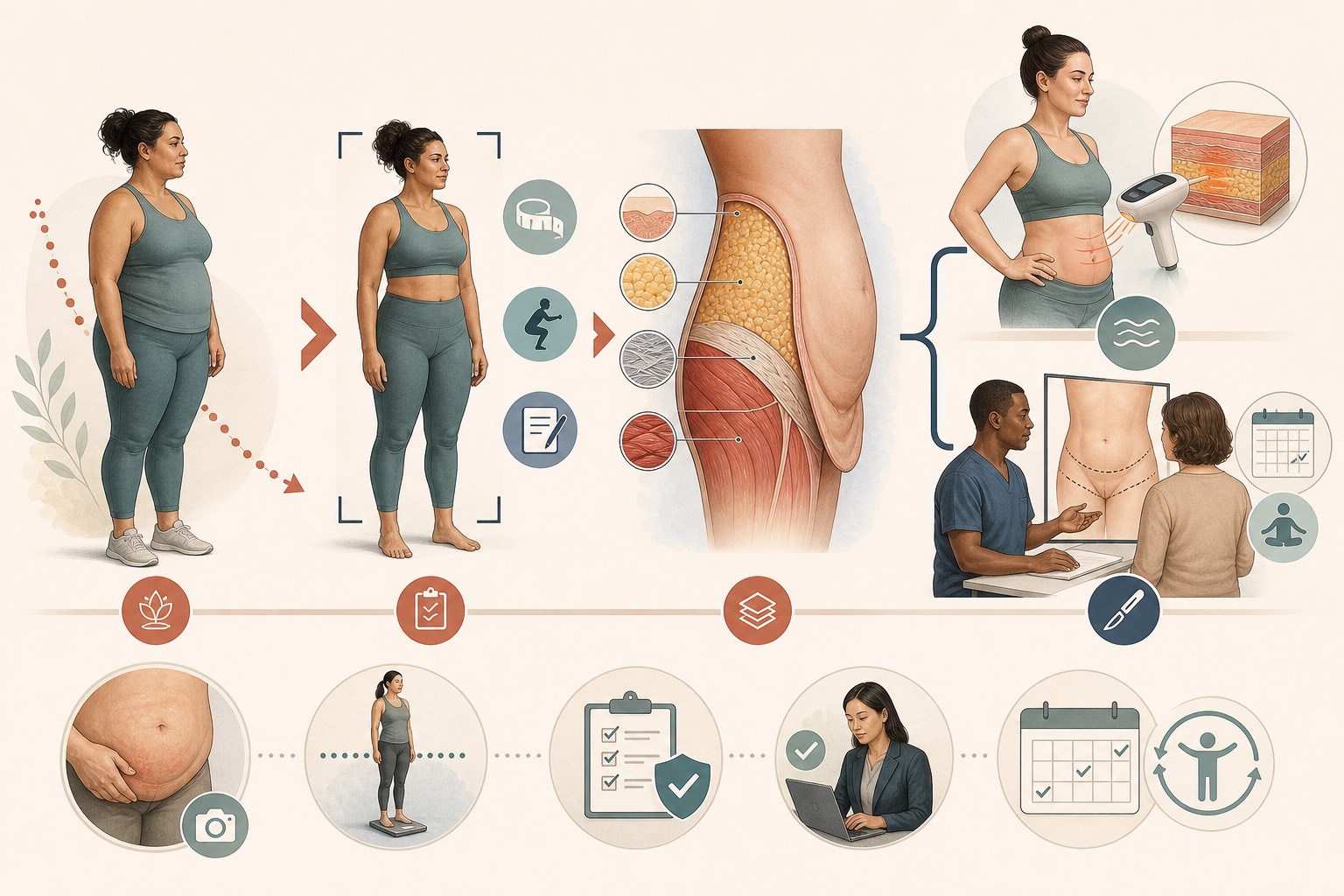
Why a photograph cannot identify the treatment layer
The skin envelope can remain larger than the contour beneath it after substantial weight loss, but visible shape also reflects remaining subcutaneous fat, connective tissue, muscle and fascia. One photograph cannot quantify those layers or diagnose diastasis, hernia, swelling or inflammation.
Resistance activity can improve strength and add muscle beneath the skin, while supportive skin care can improve comfort. Neither removes redundant skin. Non-invasive devices act at the surface or selected underlying tissue but, by FDA definition, do not excise skin or fat.
Excisional body contouring can remove selected skin and fat and sometimes address abdominal fascia, depending on the operation. The trade is a permanent scar plus anesthesia, wound, clot, fluid, contour and recovery risks; several regions may require staged procedures.
Deeper visual interpretation
Search results often collapse redundant skin, localized fat and abdominal-wall shape into one cosmetic problem. The useful first step is to identify the layer and whether the concern is visual, functional or both—before comparing a cream, energy device or operation.
| Layer or concern | What may change appearance | What a photo cannot establish |
|---|---|---|
| Skin envelope | Redundancy, elasticity, scars and fold distribution | Thickness, retraction potential or which excision is appropriate |
| Subcutaneous tissue | Remaining localized fat, uneven distribution or prior treatment | Visceral fat, tissue quality or that liposuction will tighten skin |
| Muscle and fascia | Strength, posture, diastasis or abdominal-wall contour | Diastasis, hernia or need for fascial repair |
| Fold symptoms | Moisture, friction, rash, odor, pain or skin breakdown | Infection, severity or whether urgent treatment is required |
| Pathway | Reasonable role | Important limit |
|---|---|---|
| Observation and supportive care | Consistent records, skin comfort, nutrition, movement and health optimization | No universal month or cream reliably removes significant redundant skin |
| Resistance activity | Improve strength, function and muscle beneath the skin | Does not excise skin or diagnose abdominal-wall anatomy |
| Non-invasive device | Exact-device claims may concern a small fat bulge, circumference, cellulite, muscle tone or tighter appearance | Does not remove tissue, treat obesity or equal surgical excision; results may be temporary or absent |
| Skin-removal surgery | Removes selected redundant skin and may combine other procedure-specific work | Adds permanent scars, anesthesia, wound and clot risks, recovery and sometimes staged operations |
| Symptom care | Assess recurrent rash, wounds, hygiene or mobility problems and document functional impact | Should not wait for a cosmetic package when symptoms are worsening |
Move from weight change to a defensible decision
- Keep the medicine question separate
Record the exact product and weight trajectory, but do not call loose skin a brand-specific diagnosis or listed adverse effect without label evidence.
- Standardize the observation
Repeat posture, lighting, clothing, camera distance, measurements and symptom fields instead of comparing social-media transformations.
- Name the anatomical target
Ask whether the plan addresses skin, fat, fascia, muscle, a hernia concern or fold symptoms—and what it deliberately leaves unchanged.
- Verify the intervention
For a device, record manufacturer, model, authorization and body site. For surgery, record operation, scars, anesthesia, facility and staged-plan logic.
- Plan recovery before payment
Write down restrictions, wound or burn management, urgent contact, travel, follow-up and who treats a complication in the local market.
How to interpret the stages
A recovery timeline combines broad observations from published patient guidance. It cannot know the exact product or device, treatment depth, technique, medical history, skin characteristics or aftercare plan involved in one person’s case.
Use the stages to understand the order in which changes may happen and to prepare questions for a qualified professional. Do not use a general internet timeline to override instructions from the clinician who assessed and treated you.
Aftercare principles
- Create one neutral record: weight direction, stable-period dates, standardized photos, measurements, activity or strength, fold discomfort, rash, moisture, odor, skin breakdown and prior abdominal or bariatric surgery.
- Do not label every fold as skin. Remaining subcutaneous fat, muscle or fascial laxity, diastasis, hernia and swelling can change contour and require different assessment.
- Treat moisturizers, sun protection, smoking avoidance, nutrition and resistance activity as supportive health measures—not proof that significant excess skin will retract or that surgery can be avoided.
- For a device quote, record manufacturer, model, authorized intended use and body site, expected magnitude and duration, sessions, operator, contraindications and who manages burns, numbness, nodules or unexpected enlargement.
- For surgery, ask which tissue and regions are removed, scar location, anesthesia and facility, clot and wound risks, staged-plan logic, recovery restrictions, emergency access and follow-up after travel.
Painful or spreading redness, fever, drainage, open skin, persistent bleeding, ulceration or a fold that prevents hygiene or movement needs clinical assessment rather than a cosmetic calculator. A new abdominal bulge, severe pain or vomiting can require urgent assessment for causes such as a hernia. After a procedure, breathing difficulty, chest pain, fainting, heavy bleeding, rapidly increasing swelling, severe pain, burns or rapidly worsening skin change needs prompt or emergency care under the written local plan.
Why your timeline may differ
Questions to ask before treatment
- Is the visible concern mainly skin, localized fat, muscle or fascia, a symptomatic fold, or a combination?
- Has weight and health been stable enough for this clinician's assessment and operation policy?
- What can the exact device or operation change, and what will remain?
- Where are scars, what recovery and follow-up are required, and could treatment be staged?
- Who manages rash, wounds, burns, a hernia concern or a complication after travel?
Device authorization, intended body sites, professional titles, surgical-facility rules, insurance criteria and stable-weight policies differ by market. Verify the exact device and professional locally; a U.S. FDA page or one surgical society's timeline is not worldwide clearance or personal candidacy.
Find official checks for 12 marketsHow this guide was made
5 named sources support the main claims. Each link explains how it was used, with public agencies, professional bodies or primary research preferred.
AI may assist with research organization, drafting and translation, but it is not treated as a source or credential. Read the editorial standards.
Stage bars organize a relative sequence. Original editorial illustrations are conceptual and are not clinical measurements, outcome percentages or personal forecasts.
This version has editorial evidence review, not medical review attributed to a named clinician. It does not replace an individual assessment. Editorial accountability.
Sources
- FDA: Non-Invasive Body Contouring Technologies
Defines non-invasive contouring as not removing skin or fat, distinguishes it from surgery and weight loss, and lists technology-specific limitations and complications.
- American Society of Plastic Surgeons: Body Contouring Results
Skin-removal purpose, visible scars, long settling, stable-weight context, result limits and the possibility of more than one operation.
- ASPS: Practice Parameter for Surgical Treatment of Skin Redundancy
Clinical framework for skin redundancy after major weight loss, patient evaluation, procedure planning, recovery and contour maturation.
- Chelsea and Westminster Hospital: Loose Skin After Weight Loss
Patient resource on common locations, supportive measures, functional symptoms and different skin-removal operations after weight-loss surgery.
- Systematic Review: Body Contouring and Quality of Life
Systematic review and meta-analysis of quality-of-life outcomes after post-bariatric body-contouring surgery; group evidence, not a candidacy rule or guaranteed result.
Frequently asked questions
What should I know about Loose Skin After Weight Loss?
Loose skin after substantial weight loss is not a diagnosis that a photograph or GLP-1 brand name can explain. The visible fold may combine a stretched skin envelope, remaining subcutaneous fat, muscle or fascial contour and irritation within the fold. Creams and exercise do not reliably remove significant redundant skin; non-invasive devices do not excise tissue and may produce limited or temporary change, while body-contouring surgery removes selected excess skin but adds scars, anesthesia, recovery and complication risk. Assessment is most useful when weight and health are stable enough for the responsible clinician to compare the same area and symptoms over time.
Why can the timeline differ from person to person?
Treatment type, depth, technique, anatomy, skin and tissue response, health history, medication, aftercare and complications can all change timing. The treating professional’s instructions take priority over a general guide.
When should I contact a professional?
Painful or spreading redness, fever, drainage, open skin, persistent bleeding, ulceration or a fold that prevents hygiene or movement needs clinical assessment rather than a cosmetic calculator. A new abdominal bulge, severe pain or vomiting can require urgent assessment for causes such as a hernia. After a procedure, breathing difficulty, chest pain, fainting, heavy bleeding, rapidly increasing swelling, severe pain, burns or rapidly worsening skin change needs prompt or emergency care under the written local plan.
Continue from anatomy to the exact option
Compare the complete body-contouring map, surgical abdominal recovery, device-specific limits and the clinical Mounjaro results timeline without treating any page as a personal forecast.
Open the body-contouring guide Read tummy tuck recovery Compare nonsurgical devices Read the Mounjaro results evidenceExplore the complete GLP-1 beauty and body guide
Move between product identity, side-effect timing, facial documentation, hair-loss evidence, exercise safety and private tools without turning appearance into a diagnosis or prescription decision.
Open the GLP-1 topic hub Read the GLP-1 side-effects timelineCompare the complete body-contouring options
Separate weight management, localized fat, loose skin, abdominal-wall repair, surgery and surface devices before comparing recovery or results.
Open the body contouring guideRelated beauty guides
View BodyLiposuction Recovery Timeline: Week 1 to Month 6
A visual guide to bruising, swelling, activity limits and when body-contour results become easier to see after liposuction.
Read next BODYNonsurgical Body Contouring: Recovery and Results Timeline
Compare fat freezing, heat, ultrasound and magnetic body-contouring timelines, side effects, results and device-specific risks.
Read next BODYMounjaro Face: Facial Volume Changes, Evidence and Options
What ‘Mounjaro face’ means, why facial volume may change with substantial weight loss, what evidence can and cannot prove, and how to plan a qualified review.
Read nextThis guide is for general education only. It is not medical advice, diagnosis, a treatment recommendation or a prediction of individual results. BeautiNext is not a clinic. Seek care from an appropriately qualified professional.