
Lip Flip vs Lip Filler: Differences, Results, Duration and Risks
Compare how a lip flip and lip filler work, when results appear, how long they may last and why their risks and tradeoffs are different.
Lip Flip vs Lip Filler
A lip flip uses botulinum toxin to relax muscles around the upper lip, creating a small outward turn that can make more of the lip visible without adding tissue volume. Lip filler places material in the lips to add or restore volume. Neither is a smaller or larger version of the other, and neither is automatically the better choice.
Timeline at a glance
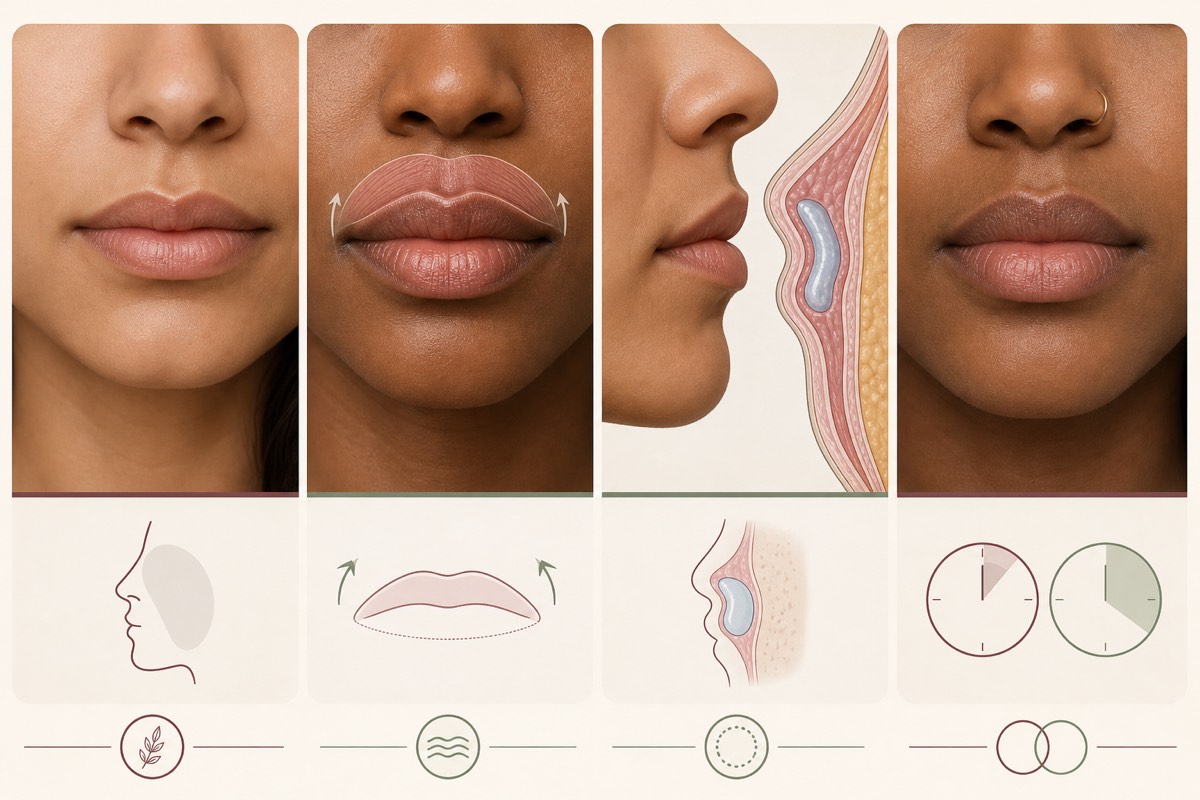
The useful comparison starts with mechanism, not price or syringe count. A lip flip changes muscle behavior; lip filler changes volume. Their result clocks, functional tradeoffs and urgent warning signs therefore need separate columns.
Define the actual concern
Ask whether the goal concerns upper-lip movement or visibility, tissue volume, shape, asymmetry or another issue. The answer may be one treatment, both or neither after an in-person assessment.
Early reactions differ
A lip flip may cause small injection-site effects and temporary functional change. Lip filler can add immediate volume mixed with swelling, tenderness and bruising that should not be judged as the settled result.
Compare at the right review point
Cleveland Clinic says a lip flip looks fuller after about one week and advises allowing two weeks before an event. Lip filler follow-up is commonly planned around two weeks, after much of the early swelling has eased.
The fading clocks are not interchangeable
Cleveland Clinic describes a lip flip as typically lasting two to five months and lip filler as typically lasting 12 to 18 months. Product, dose, anatomy and individual response still matter.
The bars show relative visibility within this guide only. They are not percentages, clinical measurements or personal forecasts.
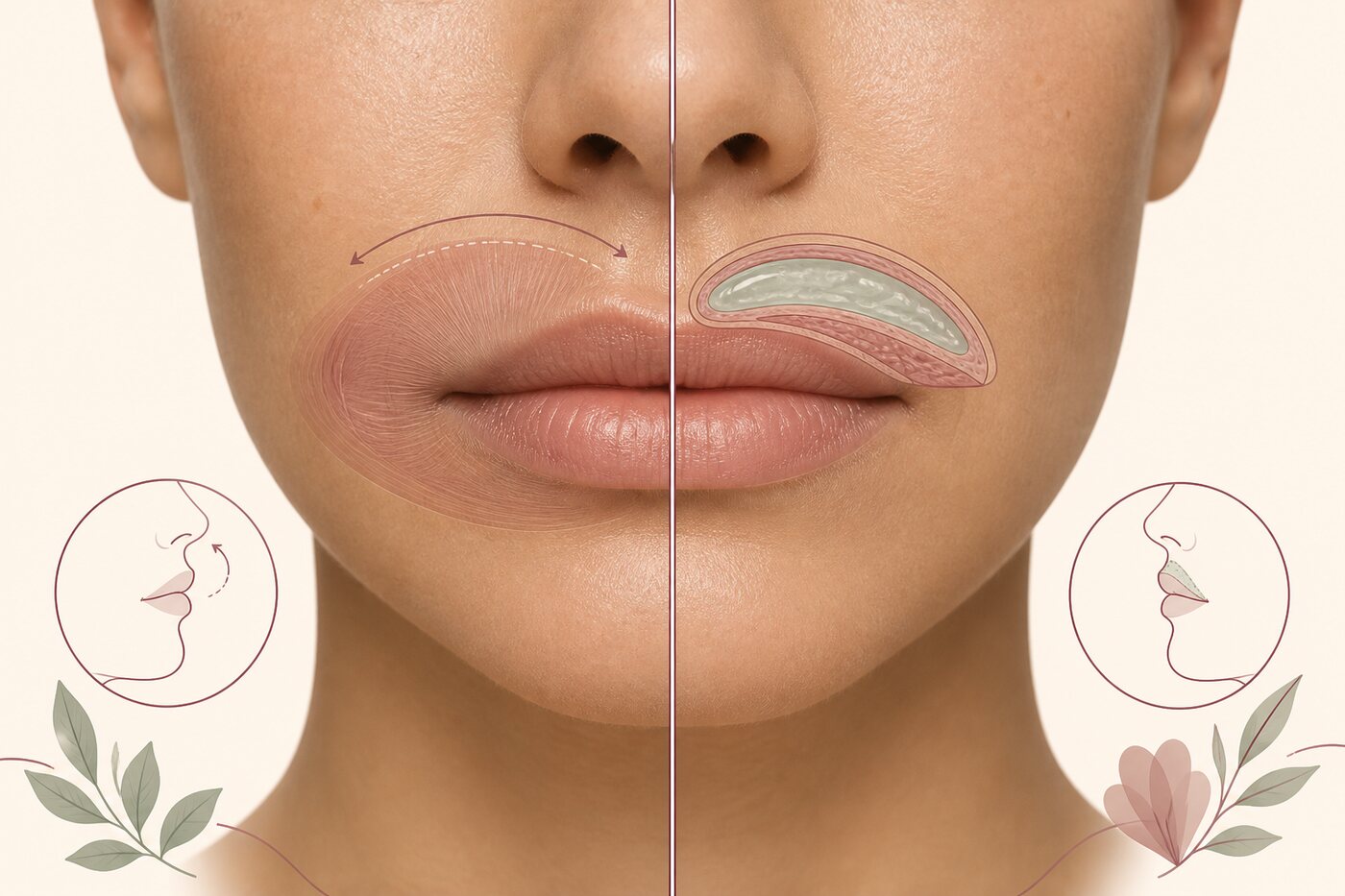
Muscle relaxation and added volume are different mechanisms
A lip flip uses a small amount of botulinum toxin around the upper lip to reduce selected muscle activity. The upper lip may evert slightly so more of its existing surface is visible, but the procedure does not place volumizing material inside the lip.
Lip filler places a dermal-filler product into selected lip tissue to add or restore volume. The treatment-day outline includes both product and a temporary injection response, so immediate fullness is not a stable comparison. The exact product, amount and placement also change what the word filler means in one plan.
Because the mechanisms differ, reversibility language needs precision. Cleveland Clinic notes that an unwanted lip-flip effect must generally be allowed to wear off. Some hyaluronic-acid fillers may be treated with hyaluronidase by an appropriate professional, but dissolution is another medical procedure and should not be marketed as a risk-free undo button.
Deeper visual interpretation
A lip flip and lip filler can both change how full the lips appear, but the shared visual description hides different anatomy. Compare the mechanism, the intended change and the distinct emergency pathway before comparing price or duration.
| Question | Lip flip | Lip filler |
|---|---|---|
| What changes? | Selected upper-lip muscle activity is temporarily reduced | Material is placed to add or restore tissue volume |
| Does it add volume? | No; slight eversion can reveal more existing upper lip | Yes; amount, product and placement affect the added volume |
| When is comparison more useful? | Effect becomes visible over about one week; allow roughly two weeks for full effect and recovery planning | Immediate volume includes swelling; follow-up is commonly around two weeks and fuller settling can take longer |
| Source-specific duration | Cleveland Clinic: typically two to five months | Cleveland Clinic: typically 12 to 18 months; product-specific evidence can differ |
| Distinctive tradeoff | Temporary difficulty drinking, speaking or controlling the lips if muscle relaxation is excessive | Swelling and bruising plus rare vascular occlusion with tissue, vision or neurologic injury |
| Urgent response | Breathing, swallowing, speaking, vision or generalized weakness symptoms need immediate help | Unusual pain, vision change, white/gray/blue skin or stroke-like symptoms need immediate medical attention |
| Observed concern | What it may suggest asking about | What the observation cannot decide |
|---|---|---|
| Upper lip rolls inward mainly during a smile | Whether selected muscle activity is contributing to reduced visible upper-lip surface | That a lip flip is suitable, safe or the only explanation |
| Low lip volume at rest | Whether tissue volume, lip shape or normal anatomy is the actual concern | Which filler, amount or placement would be appropriate |
| Difference between the two sides | Whether the difference changes with expression or stays present at rest | That either treatment will correct the cause of asymmetry |
| Perioral lines or a blurred border | Whether skin quality, movement, volume or another factor is involved | That lip augmentation is an approved or useful treatment for the exact finding |
| A request for both treatments | What separate change each component is intended to produce | That a package is safer, better value or more effective |

Make the consultation comparable
- Name the concern without naming a treatment
Describe movement, upper-lip visibility, lost volume, shape or asymmetry before asking for a lip flip or a syringe.
- Record the exact product
Write down the toxin or filler name, dose or amount, intended area, authorization context and practitioner.
- Separate the review dates
A toxin effect and filler swelling do not stabilize on the same clock. Decide when each component will be reviewed before adding another.
- Keep both emergency pathways
Save the clinic’s after-hours instructions and know which symptoms require toxin-related urgent help versus filler vascular-emergency care.
| Clock | Lip flip | Lip filler |
|---|---|---|
| Treatment-day appearance | Does not show the developed toxin effect | Includes product plus early swelling and possible bruising |
| Onset | Develops over days; Cleveland Clinic describes fuller appearance after about one week | Added volume is visible immediately, but it is mixed with the injection response |
| Review | Allow the planned interval to assess smile, speech, drinking and intended movement | Review after early swelling has eased; later integration can continue beyond the first check |
| Duration | Cleveland Clinic gives a typical two-to-five-month range | Duration depends on the exact product, material, amount, area and individual response—not one universal filler clock |
How to interpret the stages
A recovery timeline combines broad observations from published patient guidance. It cannot know the exact product or device, treatment depth, technique, medical history, skin characteristics or aftercare plan involved in one person’s case.
Use the stages to understand the order in which changes may happen and to prepare questions for a qualified professional. Do not use a general internet timeline to override instructions from the clinician who assessed and treated you.
Aftercare principles
- Record the exact botulinum toxin or filler product, intended area, dose or amount and planned review date.
- Ask specifically about temporary drinking, speaking, smiling or oral-competence changes after a lip flip rather than treating them as filler aftercare questions.
- Use the same neutral expression, lighting, angle and camera distance when comparing appearance; a smile can change how much upper lip is visible.
- Do not combine treatments simply because a package includes both. Ask what each component is intended to change and which risk pathway applies.
After botulinum toxin, seek urgent help for difficulty breathing, swallowing or speaking, impaired vision or weakness beyond the treated area. After filler, seek immediate medical attention for unusual or increasing pain, vision change, white, gray or blue skin near the injection site, facial weakness or other stroke-like symptoms.
Why your timeline may differ
Questions to ask before treatment
- Is the concern mainly upper-lip movement or visibility, missing volume, shape, asymmetry or another condition?
- What exact toxin or filler product, dose or amount and intended area are proposed?
- What temporary changes in drinking, speaking, smiling or oral control are possible?
- Which symptoms use the toxin emergency pathway and which use the filler vascular-emergency pathway?
- When will each treatment be reviewed before anything else is added?
Botulinum toxins are prescription medicines in many markets, while dermal fillers may be regulated as medical devices; authorized lip uses, minimum ages and who may prescribe or inject vary internationally. Verify the exact product and practitioner through the regulator where treatment takes place.
Find official checks for 12 marketsHow this guide was made
6 named sources support the main claims. Each link explains how it was used, with public agencies, professional bodies or primary research preferred.
AI may assist with research organization, drafting and translation, but it is not treated as a source or credential. Read the editorial standards.
Stage bars organize a relative sequence. Original editorial illustrations are conceptual and are not clinical measurements, outcome percentages or personal forecasts.
This version has editorial evidence review, not medical review attributed to a named clinician. It does not replace an individual assessment. Editorial accountability.
Sources
- Cleveland Clinic: Lip Flip
Mechanism, comparison with filler, onset, two-to-five-month duration, functional risks and urgent symptoms.
- Cleveland Clinic: Lip Fillers
Volume mechanism, early swelling, two-week follow-up, typical duration and treatment risks.
- American Academy of Dermatology: Botulinum Toxin Therapy FAQs
How botulinum toxin relaxes targeted muscles, typical effect duration and rare urgent symptoms.
- FDA: Dermal Fillers (Soft Tissue Fillers)
Filler product context, common effects, rare vascular complications and urgent warning signs in the United States.
- FDA: FDA-Approved Dermal Fillers
Why material, product-specific indication and patient labeling matter more than treating every lip filler as one category.
- American Society of Plastic Surgeons: Lip Flips and Patient Selection
Professional context on smile-related upper-lip movement, individualized anatomy and why lip flip and filler are not interchangeable.
Frequently asked questions
What should I know about Lip Flip vs Lip Filler?
A lip flip uses botulinum toxin to relax muscles around the upper lip, creating a small outward turn that can make more of the lip visible without adding tissue volume. Lip filler places material in the lips to add or restore volume. Neither is a smaller or larger version of the other, and neither is automatically the better choice.
Why can the timeline differ from person to person?
Treatment type, depth, technique, anatomy, skin and tissue response, health history, medication, aftercare and complications can all change timing. The treating professional’s instructions take priority over a general guide.
When should I contact a professional?
After botulinum toxin, seek urgent help for difficulty breathing, swallowing or speaking, impaired vision or weakness beyond the treated area. After filler, seek immediate medical attention for unusual or increasing pain, vision change, white, gray or blue skin near the injection site, facial weakness or other stroke-like symptoms.
Explore the complete lip filler guide
Move between swelling, aftercare, duration, product checks and urgent warning signs without mixing their timelines.
Open lip filler topic hubRelated beauty guides
View Aesthetic ProceduresLip Filler Swelling Stages: Day 1 to Week 4
A stage-by-stage guide to lip filler swelling, bruising, settling time, aftercare and warning signs.
Read next AESTHETIC PROCEDURESHow Long Do Lip Fillers Last? A 6-to-18-Month Timeline
How long lip filler can last, why reputable sources cite different ranges, what affects fading and why a calendar cannot predict retreatment.
Read next AESTHETIC PROCEDURESLip Filler Aftercare: Eating, Exercise, Makeup and Massage
What to do after lip filler, when to eat, exercise, use lip products or massage—and why reputable aftercare instructions can differ.
Read nextThis guide is for general education only. It is not medical advice, diagnosis, a treatment recommendation or a prediction of individual results. BeautiNext is not a clinic. Seek care from an appropriately qualified professional.