
Retinol Guide: Benefits, How to Use It and Side Effects
A sourced retinol guide covering product types, gradual introduction, expected benefits, irritation, pregnancy and ingredient combinations.
Start by identifying the product—not its marketing strength
Retinol is one member of the wider retinoid family. Cosmetic retinol, adapalene, prescription tretinoin and oral isotretinoin are not interchangeable in potency, evidence, instructions or risk. Read the exact label first, introduce one new formula at a time, use a stable moisturizer and daytime sun protection, and treat burning, widespread redness or persistent peeling as a tolerance problem—not proof that the product is working faster. Retinoids should not be used during pregnancy.
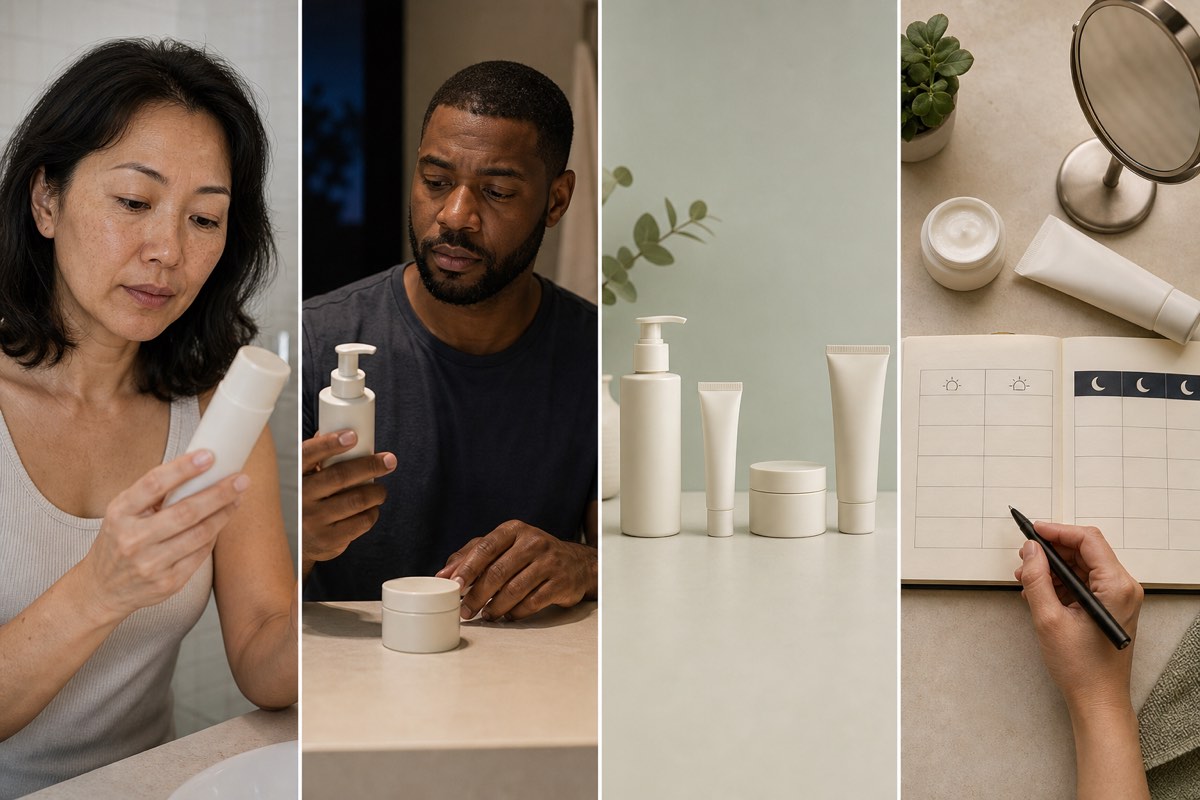
A safer retinol introduction has four decision points
This sequence organizes product identification, introduction and reassessment. It is not a countdown to guaranteed wrinkle, pigment or acne results.
Name the exact retinoid
Confirm whether the product is cosmetic retinol, adapalene, tretinoin or another topical medicine. Oral isotretinoin is a different systemic prescription and does not belong in a cosmetic routine comparison.
Test one complete formula
Use the label and dermatology product-testing guidance. Keep cleanser, moisturizer and sunscreen stable so fragrance, solvents or another active are not introduced at the same time.
Build only as tolerated
The AAD advises starting with the least-intense suitable formula and every-other-night use before slowly building up. A prescription or local label can require a different plan and takes priority.
Review the right endpoint
Acne, uneven pigment, texture and fine lines use different evidence and time frames. Compare consistent photos and symptoms over the review period for that product instead of declaring success or failure after a few days.
The bars are a visual comparison within this guide; they are not percentages or personal forecasts.
Retinol, retinoid and isotretinoin are not synonyms
The family name is useful only when the exact molecule, route and regulatory status remain visible.
| Label or term | What it may describe | Do not assume |
|---|---|---|
| Retinol | A vitamin A–based ingredient commonly sold in cosmetic skincare | That the percentage is always disclosed, standardized or directly comparable between brands |
| Adapalene | A topical retinoid medicine for acne; access differs by country and strength | That a cosmetic retinol schedule automatically applies |
| Tretinoin, tazarotene or trifarotene | Topical retinoid medicines with product-specific prescribing information | That more frequent or thicker application produces faster improvement |
| Oral isotretinoin | A systemic prescription medicine for selected severe acne cases | That advice for a facial retinol serum describes its monitoring, pregnancy prevention or adverse effects |
Choose the retinol question you need next
Retinol vs Tretinoin
Compare product status, evidence, irritation and access without turning potency into a universal recommendation.
Compare the two paths TOLERANCE · IRRITATION VS BREAKOUTSRetinol Irritation vs Purging
Compare burning, diffuse redness and peeling with changes in usual acne-prone areas without calling every reaction a purge.
Compare the patterns INGREDIENT PAIR · SALICYLIC ACIDSalicylic Acid and Retinol Together
Separate a rinse-off cleanser, leave-on acne product, professional peel and wart remover before choosing a schedule.
Check the product types INGREDIENT PAIR · VITAMIN CRetinol and Vitamin C Together
Distinguish one overall regimen from one application and use morning/evening separation as a practical—not universal—default.
Open the routine guide INGREDIENT PAIR · NIACINAMIDENiacinamide and Retinol Together
Compare a co-formulated product with two separate serums and the limits of claims that niacinamide guarantees less irritation.
Read the evidence checkBefore starting: check the formula, skin and plan
- Read the exact ingredient, intended use, amount, frequency and warnings on the local label or prescription.
- Introduce one new active formula at a time; do not begin retinol, an exfoliant and a new cleanser together.
- Keep a tolerated moisturizer and broad-spectrum daytime sunscreen in the routine, and avoid applying to sunburned or significantly irritated skin.
- Discuss persistent acne, scarring, eczema, rosacea, strong inflammation or pigment changes after irritation with a qualified clinician.
- Do not use retinoids during pregnancy. Ask an appropriate clinician about pregnancy planning, breastfeeding and any prescribed retinoid.
Cosmetic definitions, percentage disclosure, over-the-counter access and prescription status differ by country. Verify the exact ingredient and local label instead of importing another market’s routine or treating every product called retinol as equivalent.
Open official checks for 12 marketsStop the new product and seek professional advice for marked swelling, hives, blistering, eye involvement, intense pain, a widespread rash or irritation that does not improve after stopping. Breathing difficulty or swelling of the face, lips, tongue or throat requires emergency care. Painful, deep, scarring or steadily worsening acne also deserves an individualized assessment.
How this guide was made
6 named sources support the main claims. Each link explains how it was used, with public agencies, professional bodies or primary research preferred.
AI may assist with research organization, drafting and translation, but it is not treated as a source or credential. Read the editorial standards.
The hub connects focused guides and organizes decision points. Its stage bars are navigation aids—not clinical scores, measured outcomes or treatment rankings.
This version has editorial evidence review, not medical review attributed to a named clinician. It does not replace an individual assessment. Editorial accountability.
What the evidence can—and cannot—answer
Professional guidance supports gradual introduction and product-specific instructions. Trials test defined formulations and populations; they do not validate every cosmetic bottle, concentration, social-media schedule or ingredient combination.
- American Academy of Dermatology: Retinoid or Retinol?
Retinol and retinoid distinctions, suitable users, gradual introduction, irritation, skin-of-color context and pregnancy restriction.
- American Academy of Dermatology: How to Test Skin Care Products
A seven-to-10-day method for screening a new skincare product on a small test area and what to do if a reaction develops.
- American Academy of Dermatology: Acne Diagnosis and Treatment
Role of topical retinoids in acne care, irritation reduction, evening use, moisturizer and sun protection.
- Cleveland Clinic: Retinol
General retinol overview, application sequence, possible benefits, irritation and routine adjustments.
- Topical Retinoids in Acne Vulgaris: A Systematic Review
Systematic review of 54 topical-retinoid acne trials showing efficacy alongside meaningful tolerability differences.
- Topical Retinol for Photoaged Facial Skin: A Vehicle-Controlled Trial
A 26-week split-face trial of one 0.075% retinol cream in 57 middle-aged Japanese women; useful formula-specific evidence, not a universal cosmetic timeline.
Retinol questions
How often should a beginner use retinol?
There is no universal schedule for every product. The AAD describes beginning with the least-intense suitable formula and every-other-night use before slowly increasing, while a prescription and the exact product label take priority.
How long does retinol take to work?
The endpoint matters. Acne, pigment, texture and fine lines are studied with different products and review periods. Clinical trials commonly assess defined formulas over weeks or months, which cannot promise that an unrelated cosmetic product will change your skin by the same date.
Can retinol be used with vitamin C, niacinamide or salicylic acid?
They can appear in one overall regimen, but formula, product type and tolerance matter. Use the focused guides above to separate a co-formulated product from two independent leave-on products and to choose a lower-complexity schedule.
Is peeling proof that retinol is working?
No. Dryness, stinging, redness and peeling are signs of irritation and do not measure benefit. Reduce complexity, follow the label and seek advice when symptoms are marked, spreading or persistent.
This hub provides general education, not medical advice, diagnosis, a treatment recommendation or a personal result forecast. BeautiNext is not a clinic.