
CO2 Laser Resurfacing Recovery: Day-by-Day Timeline and Risks
CO2 laser recovery from the first three days through surface healing, persistent redness and pigment risk—with fractional and fully ablative differences.
CO2 Laser Recovery Timeline
CO2 laser resurfacing does not have one recovery time. Fractional treatment leaves untreated skin between microscopic columns and often returns people to routine sooner than fully ablative resurfacing, while intensity and treated area also matter. Published patient guidance places broad surface healing around one to three weeks; pinkness, redness and pigment change can persist for weeks or months. Your own clinician's wound-care, medicine, makeup and sun instructions override a generic calendar.
Four recovery clocks at a glance
Track four separate clocks: wound care, surface closure, social visibility and longer color or texture change. Being ready to work is not proof that the barrier has healed, and a closed surface is not the final result.
Identify the exact resurfacing plan
Record whether treatment is fractional or fully ablative, the device, area, intensity, eye protection, anesthesia, infection prevention and the clinician's written wound-care plan.
Protected wound-care phase
Heat, stinging, swelling and marked redness are common; more aggressive treatment may ooze or crust. Cleanse, dress and use prescribed products only as directed, and do not pick.
Peeling and surface healing
Dryness and peeling often develop. ASPS describes peeling around day five to seven, while Cleveland Clinic gives a broad 10-to-21-day healing range that changes with treatment intensity.
Color and result continue to change
Pinkness or redness can remain after the surface closes, and darker or lighter pigment may emerge later. Standardized review matters more than judging a day-seven glow or one filtered photograph.
The bars organize recovery attention only. They are not wound-depth measurements, laser settings, severity grades, clearance dates or result forecasts.
Why one CO2 laser name can hide very different injuries
A CO2 laser emits 10,600-nm infrared light that is strongly absorbed by water in tissue. Ablative resurfacing deliberately removes or vaporizes tissue and creates a wound that must re-epithelialize; it is not interchangeable with a home LED mask, IPL, a nonablative laser or RF microneedling.
Fully ablative treatment removes a continuous surface, while fractional ablative treatment creates microscopic treatment columns separated by untreated skin. Device, energy, density, pulse, passes, overlap, area and operator technique can change both effect and recovery, so the word fractional is not a fixed dose or guarantee of mild downtime.
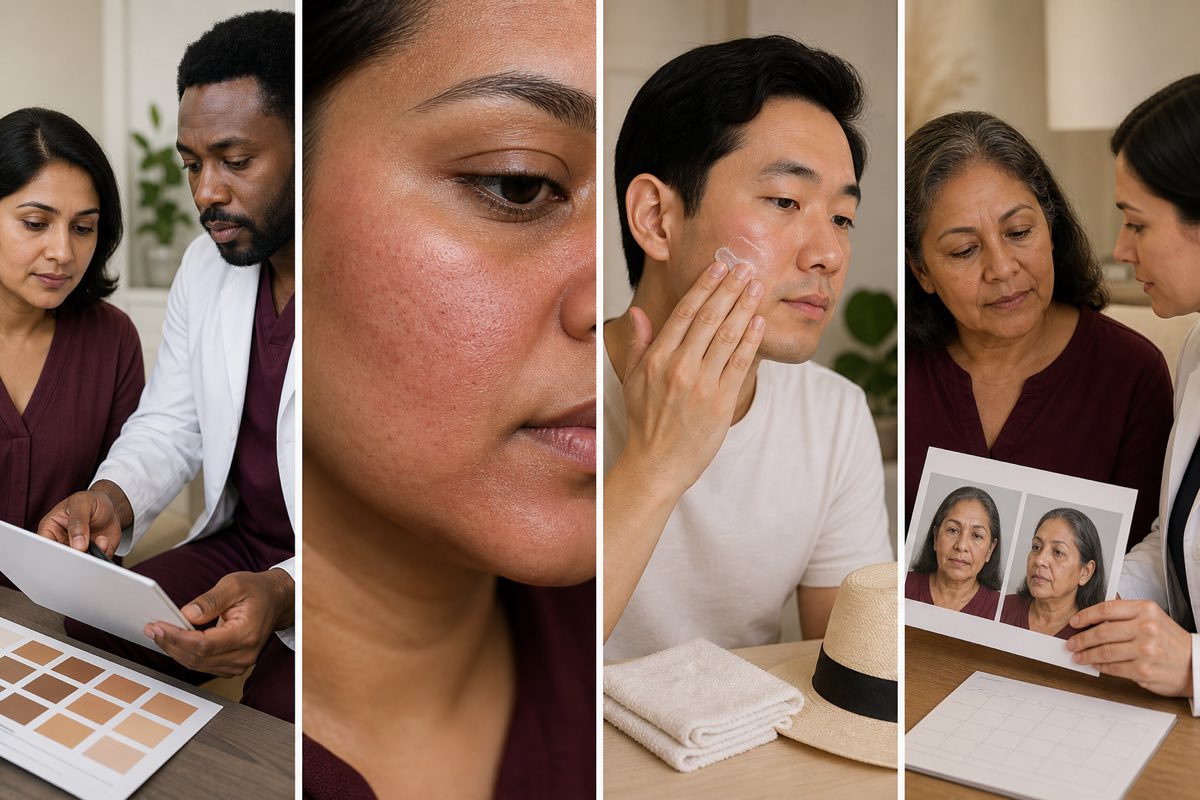
The visible endpoint also changes by skin tone. Redness can be less obvious in richly pigmented skin, while post-inflammatory hyperpigmentation, hypopigmentation and scarring remain important risks. A provider's experience with the relevant skin tone and indication belongs in the safety assessment.
Deeper visual interpretation
The most useful question is not ‘How many days is CO2 downtime?’ It is which tissue was treated, how continuous or fractional the injury was, when the surface is expected to close and which later color changes need follow-up.
| Treatment label | Tissue effect | Recovery implication |
|---|---|---|
| Fully ablative CO2 | Removes a continuous surface to a selected depth | Usually more intensive wound care and longer redness; the plan cannot be inferred from a fractional-laser post |
| Fractional ablative CO2 | Creates microscopic ablative columns separated by untreated skin | Often faster surface recovery, but density, energy, passes and area still create a wide range |
| Nonablative fractional laser | Heats selected tissue without intentionally removing the full surface | Different wound-care and downtime expectations; it is not a lighter setting of the same CO2 procedure |
| Erbium ablative laser | Uses a different wavelength and tissue interaction | May have a different recovery profile; its calendar does not automatically describe CO2 |
| LED, IPL or RF microneedling | Different energy source or delivery pathway | Benefits, risks and aftercare cannot be transferred because marketing uses the word resurfacing |
| Clock | Useful endpoint | Common mistake |
|---|---|---|
| Wound care | Exudate, crusting, cleansing, dressing and medicine instructions | Using a skincare routine before the treating team permits it |
| Surface closure | Clinician-confirmed re-epithelialization and permission for products or makeup | Assuming less redness means an intact barrier |
| Social visibility | Comfort with residual redness, peeling or camouflage after healing | Calling return to work complete biological recovery |
| Color and result | Stable standardized images over weeks or months | Judging pigment, scar texture or final benefit during swelling |
Build a recovery plan before the appointment
- Name the exact procedure
Record device, fractional or fully ablative delivery, indication, treated area, settings summary and operator instead of writing only ‘CO2 facial.’
- Prepare the protected phase
Obtain written cleansing, dressing, ointment, medication, sleeping, contact and urgent-care instructions before the skin is tender.
- Separate return dates
Plan wound care, remote or public work, makeup, exercise, heat, swimming, travel and active skincare as separate questions.
- Schedule color follow-up
Use fixed photographs and a clinician review for persistent redness, darker or lighter patches, grid marks, scars or a result that is not evolving as expected.
How to interpret the stages
A recovery timeline combines broad observations from published patient guidance. It cannot know the exact product or device, treatment depth, technique, medical history, skin characteristics or aftercare plan involved in one person’s case.
Use the stages to understand the order in which changes may happen and to prepare questions for a qualified professional. Do not use a general internet timeline to override instructions from the clinician who assessed and treated you.
Aftercare principles
- Keep the written plan for cleansing, dressings, ointment, medicine and contact details beside you before treatment. Do not substitute a viral routine for procedure-specific wound care.
- Do not scratch, peel or pick crusts. Ask before applying makeup, retinoids, exfoliating acids, vitamin C, fragrance, topical antibiotics or a product not included in the plan.
- Use only the cooling and elevation instructions provided by the treating team. Direct ice, excessive occlusion or prolonged use of an unapproved ointment can create separate problems.
- After the clinician confirms surface healing, use the recommended broad-spectrum sun protection and physical protection. Heat and UV exposure can worsen redness or pigment change.
- Use the same camera, angle, distance, expression and diffuse light for review. Record symptoms separately because an image cannot show pain, heat, discharge or visual change.
Contact the treating team promptly for worsening rather than improving pain, spreading redness, pus or foul discharge, fever, grouped blisters, new ulcers, marked swelling, delayed healing, eye pain or visual symptoms. Seek urgent care for severe eye symptoms, rapidly progressive swelling, breathing difficulty or another emergency. Burns, infection, scarring and skin-color change require direct assessment, not an online timeline.
Why CO2 recovery can differ so widely
Questions before scheduling CO2 resurfacing
- Is the plan fractional or fully ablative, and what exact device, area, settings and number of passes are proposed?
- What is the intended diagnosis or cosmetic endpoint, and what result does the clinician not expect this treatment to change?
- How does my skin tone, pigment history, melasma, scarring tendency, cold-sore history, medication or recent procedure change risk and preparation?
- Which cleanser, dressing, ointment, medicine, sunscreen and emergency contact instructions will I receive in writing?
- What dates should I reserve separately for wound care, public-facing work, makeup, exercise, travel and the first meaningful result review?
Who may operate a medical laser, where treatment may occur and how a device is regulated vary by country and sometimes by state or province. A U.S. FDA device record does not license a practitioner or authorize identical use worldwide. Verify the exact professional, facility and device through the regulator where treatment will occur, especially when traveling.
Find official checks for 12 marketsHow this guide was made
6 named sources support the main claims. Each link explains how it was used, with public agencies, professional bodies or primary research preferred.
AI may assist with research organization, drafting and translation, but it is not treated as a source or credential. Read the editorial standards.
Stage bars organize a relative sequence. Original editorial illustrations are conceptual and are not clinical measurements, outcome percentages or personal forecasts.
This version has editorial evidence review, not medical review attributed to a named clinician. It does not replace an individual assessment. Editorial accountability.
Sources
- Cleveland Clinic: Carbon Dioxide Laser Resurfacing
CO2 mechanism, 10-to-21-day broad healing range, longer redness, wound care, infection, scarring and hyperpigmentation context.
- American Society of Plastic Surgeons: Laser Skin Resurfacing Recovery
Early reaction, peeling around day five to seven, clinician-directed cleansing and protection, prolonged pinkness and treatment-dependent recovery.
- Mayo Clinic: Laser Resurfacing
Ablative, nonablative and fractional distinctions; preparation, recovery and higher long-term color-change risk in brown or Black skin.
- Johns Hopkins Medicine: Laser Skin Resurfacing
Ablative and nonablative context, healing expectations, active-wound and infection precautions and possible adverse effects.
- FDA: Medical Lasers
Medical-laser definition, non-ionizing light, device regulation and risks including pain, infection, scarring and skin-color change.
- ASLMS: Resurfacing Primer
Technical overview of 10,600-nm CO2 absorption, fully ablative versus fractional delivery and the tradeoff between downtime and adverse-effect risk.
Frequently asked questions
What should I know about CO2 Laser Recovery Timeline?
CO2 laser resurfacing does not have one recovery time. Fractional treatment leaves untreated skin between microscopic columns and often returns people to routine sooner than fully ablative resurfacing, while intensity and treated area also matter. Published patient guidance places broad surface healing around one to three weeks; pinkness, redness and pigment change can persist for weeks or months. Your own clinician's wound-care, medicine, makeup and sun instructions override a generic calendar.
How long does CO2 laser resurfacing take to heal?
Published patient guidance gives broad surface-healing ranges from about one to three weeks, but fractional versus fully ablative delivery, intensity, treated area and complications change the clock. Redness or pigment change may persist much longer, so surface closure, return to work and final review must remain separate.
Why can the timeline differ from person to person?
Treatment type, depth, technique, anatomy, skin and tissue response, health history, medication, aftercare and complications can all change timing. The treating professional’s instructions take priority over a general guide.
When should I contact a professional?
Contact the treating team promptly for worsening rather than improving pain, spreading redness, pus or foul discharge, fever, grouped blisters, new ulcers, marked swelling, delayed healing, eye pain or visual symptoms. Seek urgent care for severe eye symptoms, rapidly progressive swelling, breathing difficulty or another emergency. Burns, infection, scarring and skin-color change require direct assessment, not an online timeline.
Compare two complete CO2 laser quotes
Enter written session or package prices with anesthesia, facility, aftercare, travel and time-away costs in a private 12-currency calculator.
Open the CO2 laser cost calculatorCompare other professional resurfacing routes
Separate CO2 ablation from mechanical microneedling and chemical peel depth before comparing a package, downtime or acne-scar claim.
Open companion guideOpen the complete acne scar guide
Start with active acne, flat marks, depressed or raised scar patterns and skin-tone context before comparing exact procedures.
Explore the acne scar topic hubRelated beauty guides
View SkincareMicroneedling Aftercare Timeline: First 24 Hours to Week 1
What redness, sensitivity and visible recovery can look like after microneedling, with aftercare and safety notes.
Read next SKINCAREMicroneedling vs Chemical Peel: Scars, Pigmentation, Downtime and Risks
Compare microneedling and chemical peels for acne scars, pigmentation, skin tone, downtime, treatment series, procedure-specific risks and questions to ask.
Read next SKINCARERetinol vs Tretinoin: Strength, Results, Irritation and Use
Compare cosmetic retinol and prescription tretinoin by product status, evidence, irritation, routine use and pregnancy precautions.
Read nextThis guide is for general education only. It is not medical advice, diagnosis, a treatment recommendation or a prediction of individual results. BeautiNext is not a clinic. Seek care from an appropriately qualified professional.